Sunday, June 11, 2017

Day 4-5 Sailing from Portland to San Diego

May 30th and 31th of 2017

Postscript [ Bill made a great lasagna and salad for dinner last night. Last night's book showed that we had dolphins off our bow near Coquille Oregon. ]

May 30th Day 4.

We are making fairly good time averaging about 6.6 knots speed over ground.  I came on watch at midnight and the swells have gotten large.  We're about 25 miles north of Coos Bay, Oregon.  I don't know much about Coos Bay other than it's favorite son, Steve Prefontaine.  I always remember his quote, "To give anything less than your best, is to sacrifice the gift."


By noon we shifted course to 180o due south!  Bill made grilled cheese for lunch.


At 1425 we heard a call from the U.S. Coast Guard of a vessel in distress 10 miles west of us.  The vessel's engine was having trouble.  We responded to the Coast Guard's call that we could assist if needed.  They responded that the vessel's captain wanted to be towed back to Lincoln City Oregon rather then the closer harbor of Coos Bay.  We notified them that we were not going backwards to help in the assist.

Winds were light through the day, not enough to sail so we gently motored all through the day.

The light winds and the slow motoring was great for whale watching, because they tended to stay some distance away from the boat.


Hamburgers for dinner tonight, they were very good.

My last log entry and plotted fix before hitting the sack at 8:00pm showed we were 6.5 hours from California and Oregon boarder.


May 31th Day 5.

When I came on shift we'd just entered California's waters. Still no winds at 25 miles off shore.  made a list of the things to do for the next day.  We checked the oil, added some to the engine.  We checked the transmission fluid, engine mounts, through holes valves, bilge, changed fuel tanks, cleaned up, and had everyone shower and ready for the coming day.  

We set the main and the stay sail and made way at about 4.5 knots average.  Paul was burning through the paperbacks when he was off watch.  


At one point while I was on watch the whales got a little too close.  if you look closely in the photo below you'll see the whale (darker colored water less then 4 feet from the boat).


My watch ended, for the day.  Once again Bill set me up with his espresso and biscuit.


Saturday, June 10, 2017

Day 2-3 Going to San Diego - Bill takes us across the bar

May 28th and 29th of 2017

Postscript [ I should say for the record that a few days ago when Donnie dropped in the new muffler.  When I started the boat both Paul and Donnie saw white smoke, hot water and small white feathers coming from the exhaust port.  It's an important detail for the reader for later in the saga. ]

Bill takes us across the bar -

Crossing the Columbia River Bar for sailors is a big deal.  The bar is known as the grave yard of the Pacific Ocean, with over 2000 large ship wreck tallied through the years.  It is so dangerous that the bar pilots are paid over $180,000 a year to bring in ship today.

Meriwether Lewis and William Clark arrived in July of 1806 being so impressed they named it Cape Disappointment, so there isn't much more to say about the place.

The bar is about 6 miles long and three miles across.  The "green side" (following the green buoys) as I call it lies to the north of the bar just off the North Jetty. The green side hugs the large rock wall creating large waves if you ride across that side.  The only time I ever came through the green side was going up to Barkley Sound some years ago following S/V Rowena.  Alicia on Rowena reported seeing 60% of the CarolMarie's bottom as we topped wave after wave.

The "red side" of the bar (following inside the red buoys) as I call it, only comes close to the south jetty at it's very end.  With mostly northerly winds staying off the south jetty going out makes a smoother ride.  Dealing with the westerly swells becomes the only concern.   Our plan was to be out on the bar a little before the outgoing tide and have it propel us outward to sea.

Columbia Bar - Black Lies show the North and South Jetties while the red and green lines show their respective sides.


May 28th Day 2.

We woke up early, Bill made coffee and oatmeal for us all. Afterward I went through the checklist with the crew.  We checked the transmission, transmission fluid, tied down the heat exchanger that had worked itself loose, checked engine mounts, changed the water pump just in case, checked and added oil.  We ran the Jacklines, set up the stationary tethers in the cockpit and the dynamic ones on the port and starboard Jacklines.

Meanwhile Bill made sandwiches for lunch and dinner in case of a bad bar crossing or rough seas.  Bill prepared the galley and provisions for the crossing and the open ocean.

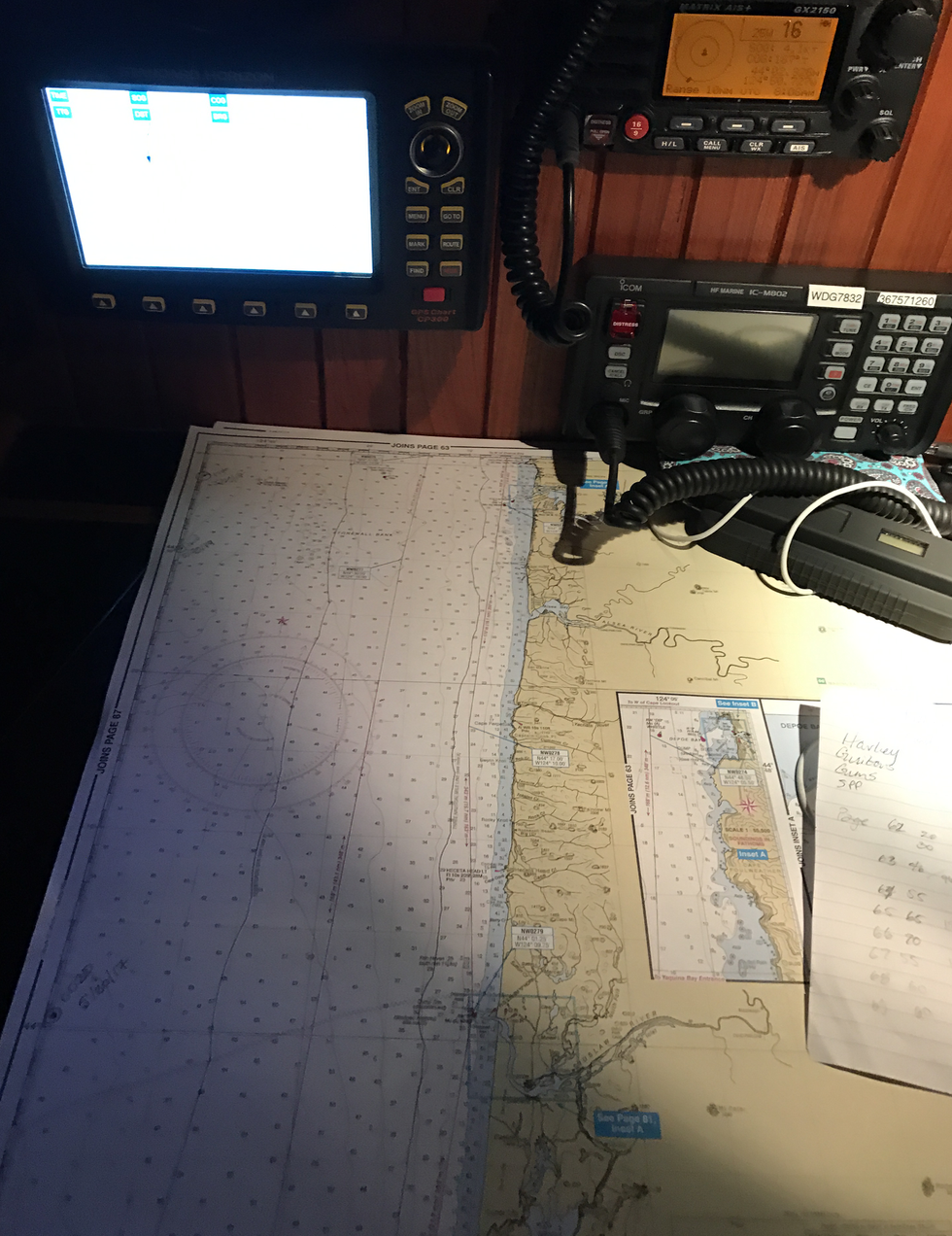
Next was to check the SSB before heading out to sea.  Some time ago we installed an ICOM M802 aboard as the new SSB.  The marine single sideband transceiver operates on frequencies in the shortwave spectrum between 2 MHz and 26 MHz. These short wavelength frequencies refract radio signals off the ionosphere, reflect off sea water, and may easily skip hundreds and thousands of miles around the earth. We had never tested our SSB at a distance. Before leaving I spoke to my good friend Jim Noval who badly wanted to go on the journey but couldn't but said he'd be our radio hop to Charing and Theresa.  Jim's boat S/V Ranidan would call us on SSB at set times.  The protocol was to begin every day at 9:30am on 4.146 Mhz if no answer  after 5 minutes we'd go to 3.968MHz and then again after 5 minutes to 7.238MHz.  We would repeat the protocol until 10:00am Pacific time.  Although we tried it appeared Jim's boat needed a setting changed.  So we counted on our cellular phones and VHF as our communication means.  Bill brought along a SPOT Satellite GPS Messenger to send our positions back to shore as needed.

We were so busy the morning past quickly; we'd almost missed our chance to cross the bar.  Based on the schedule I had the sack tide was around 2:00pm.  Astoria West Basin is 14 miles from the bar so we needed to leave at 11:30am. With the tide coming in we'd being losing 2 knots to our speed of 5 knots. We left the dock right at 11:30.

Leaving the West Basin Marine on the Columbia River

Upon leaving the dock and entering into the Columbia River, Paul and I set the main sail with a single reef.  Once the main sail was set we accelerated beginning the voyage again.

While waiting to approach the bar we had our lunch thanks to Bill.  He'd made these wonderful cheese spread sandwiches.

Bill having lunch and watching the river traffic.
Since the CarolMarie moves slowly we were soon being followed and overcome by the fishing fleet heading out to sea, taking advantage of the slack tide.

Fishing boat passing us on the river as we went out.

The stretch to get to bar is always a long one.  Often the marine layer of clouds makes the entire setting that much more ominous, which only heightened our anticipation as we approached the bar.


Long approach to the bar looking at Ilwaco, Washington

Bill had told me days before that he'd always wanted to cross the bar after having learned about it's infamous history.  I gave Bill the pleasure then of having the helm as we passed along the "red side". 

Following the "red side"
We weren't long out on the bar when we first started feeling the effects of the Pacific swells and the waves.  Bill stood firm behind the helm, with Otto (autopilot) doing the actual steering.  One by one we passed the red buoys leaving the bar behind.

Our man Bill taking us out to open water
Looking back to Cape Disappointment we were now in a new environment, the Northwest Pacific, and needed to deal with her swells and waves as we made way.

Looking back at Cape Disappointment
About 15 miles out from the bar we set the stay sail, set the course south.  A nice northerly breeze pushed us along.

Set sail for the night
Because of the seasick patches and the last two mornings of early starts the crew was tired.  We had a quick meeting, about the watch schedule. Each man would do four hours through the night in a dog watch.  First watch was Bill from 2000-0000, I was on second from 0000-0400 and Paul did the morning watch from 0400-0800.  Because it was early in the day still I said I would take the watch until after dinner was finished.

Paul off watch nap


Bill off watch
Bill's first dinner was great, he'd settled into the galley well.  Paul learned everything about the boat quickly and set in as first mate.  After dinner I climbed into my bunk, slept until my watch came up.  The first night at sea was easy, a gentle pitching and rolling but we were doing about 4.5 knots in the water and pushed along by a 0.5 knot current.

Through my watch, I could see sometime flying off our stern, back and forth in front of the light.  I thought it must be a small bird, eating bugs attracted by the light.  At 0400, Paul came up and I went down to bed again.


Sailing along
The next morning when I awoke the crew was up, and the smell of coffee filled the damp cabin.  With seventy miles behind us, we began to find a rhythm at sea.  The 9:30am radio check didn't work either.  I phoned Jim and he reported he was able to hear my call, but I wasn't able to hear him.

Bill on watch the next day
Watches when on through the day, while the ship gently rolled and pitched in the swells.  Bill found the espresso pot treating us to afternoon coffee and biscuits.

End of watch treat
By the afternoon of the second day we were now 25 miles offshore, making way at 5.5 to 6 knots.  As the day went on two stowaways appeared. 
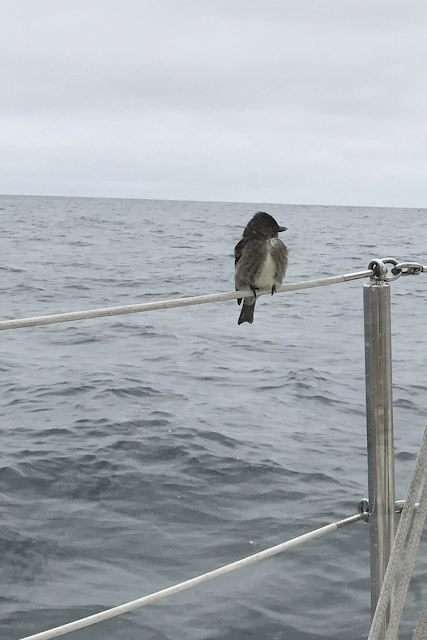


Stowaway #1


Stowaway #2

The stowaways kept us entertained until through the day.  Bill cooked dinner again and we fell into our nightly watch pattern.


Friday, June 9, 2017

Day 1 Going to San Diego

"Dawn comes early on a boat... everyday day just about sun up"

May 27th, 2017

It was best said by the character Captain Ron from the movie of the same name, "Dawn comes early on a boat... everyday day just about sun up".  We gathered at the boat at 5:30am just in time to see the dawn breaking over the Columbia River across the Hayden Bay.


Charing, Theresa, Bill, Paul and his son, and I gathered at the boat and stowed the last of the supplies away.  Bill went to work packing the items need in the refrigerator locker so he knew where things were.  Paul filled the boat's water tanks full, while I did last minute preparations on storing and uncovering the boat.

As 6:00am rolled around we took a quick crew photo and through off the dock lines.


As the sun continued to rise we motored off into the bay and onto the Columbia River.  It was hard knowing that it was the last time I would motor my CarolMarie out of the bay and the Hayden Island where she'd spent all of her life.


When we hit the Columbia the river's current made itself known.  The high amount of rain water from the long winter was all now running off the mountains creating a fast river current.  I immediately called the Interstate 5 Bridge for a lift.  The CarolMarie's highest point from the water line is 62 feet, with the small waves I always ask for at least 64 feet of clearance under the river bridges.

I-5 Bridge

Isn't wasn't long before the bridge tender opened the bridge and we were rapidly push through the pillars by the churning green water.

I-5 Closing
As it closed, I watched and Charing rushed in the car to take a photo of us from the bridge.  Unfortunately she was too late, she got stuck in traffic.

Next was the last swing for us of the Vancouver Railroad Bridge.  As it swung open all I could think about was this was the last time through these two bridges.  Bridges I had opened so many times for cruising and voyaging up and down the river on three different boats.  Now it was time to say good by to them both.

Vancouver Railroad Bridge

With the motor at 1800 rpm (70% of maximum throttle) we did about 9.3 knots SOG (speed over ground) do to the heavy current.

We passes by Sauvie Island as the sun began to warm the air, and the realization of the journey's start sank into me.   For many years working in technology I dreamed about the day when I would go down the Columbia, hit the Pacific and make that big left hand turn.  Well today was the day I thought about so many times before.

I was sad to see the places I had spent my free time at pass by as we made way down river.

Scenic Sauvie Island

Now that we had begun our journey I woke up the fourth crew member Otto, the Auto-Pilot.  Otto works tirelessly without much complaining.

Otto mounted to the right of my foot
Otto has a long remote control cable allowing us to sit anywhere on the boat and steer her.  St. Helen's, Oregon and the end of Sauvie Island came quickly.  It wasn't long before we were passing Rainer coming up to the Longview Bridge.

Rainer, Oregon

Once your at Rainer, bridging the river in front of you is the tall Longview Bridge.  From our home in Oregon there are four bridges to pass to hit the ocean, and we were now approaching the third of four.

Longview Bridge
We traded watches through the day with four hours on and eight hours off. Below Paul is on watch, giving Bill insights into traffic on the Columbia River.

Paul (yellow coat) and Bill (black cap) on watch.

The next milestone to pass was Cape Horn on the Columbia.  Cape Horn is a large ridge that hugs the river acting as a wind barrier for short distance, but later accelerates the wind as you near it's end.  We have been at Cape Horn where the winds were 30 knots on the nose, and other times when it's been calm and still.  As we approached Cape Horn the winds were 15-18 on the bow of the boat.

Approaching Cape Horn
Cape Horn didn't bother Paul at all.  Like an experienced cruising sailor he'd brought an entire brown paper bag full of paperback novels.  Since he wasn't at watch he settled in, and enjoyed the Oregon summer sun.

Paul decked out in his summer attire.
As we approached the open waters of Astoria Bay traffic began coming in from sea.

Traffic on the River

The bay was extremely windy and choppy making the last five or so miles a rocking and rolling ride.

Buoy on the bay


 But finally the welcome site of the city on the hill, Astoria.

Astoria
There was only one more bridge to go under and then we'd enter into the West Basin Moorage in Astoria.

Going under the Astoria Bridge
We had called earlier in the day and reserved an end tie. We came in about 6:30pm a 12 hour ride from Hayden Bay.

CarolMarie tied up at the West Basin Marina
We walked up to a tavern called the Portway, which is famous for being haunted.


After a great meal we took showers, put on our seasick patches and turned in.  Tomorrow we will cross the bar about 2:00pm as slack tide approaches.

Putting in the New Muffler and Provisioning

May 26th, 2017

Continuing on the saga to get south began early in the morning with Paul arriving with the modifications to the muffler.  He had added a build up layer of fiberglass to increase the diameters of the intake and output of the new muffler.  Early in the morning he ground down the excess in the driveway to fit the new muffler.


After grinding it down and a couple of cups of coffee it was off to the marina to install the new muffler.  Down at the dock there waiting for us was Donnie on her boat.  She immediately went to work and installed the new muffler.


First it took a bit to get in place, as it was a tight fit to begin with.  Once she did fit the muffler clamping on the hoses was the next challenge.

'
With the muffler in place we said goodbyes to Donnie, and set off to Donaldson's for diesel.

The CarolMarie carries 140 gallons of diesel in two 70 gallon tanks, and we filled both of them at a cost of 2.25 a gallon.  We returned to the docks at Hayden Bay Condos and added more supplies on board.


Bill Crowell was our volunteered cook for the voyage.  Between Charing, his wife Theresa and himself the boat was soon fully stocked ready to leave the next day.  It was just a matter of carting it all down to the boat from the houses.


Now we are ready to leave on the first leg to Astoria.