Tuesday, September 2, 2014

Sailing on a Reach and a Land Cruise

Once again we took friends out for an afternoon sail on Saturday.   The weather didn't cooperate, winds out of the ESE making the trip a reach each way between the I5 and I205 bridges.  We caught a rare glimpse of a catamaran on the water here in Portland.   This one hails from Maryland, so it came along way to be running on the treadmill of the Columbia River.


We did have a beautiful sunset which we caught on camera.


I did some maintenance on the boat too this weekend adding a couple of lights which were missing.   The first light was over the chart table, enabling lighting of the switch panel and chart table.


The second light was in the hall over the forward closet.


Finally this weekend we took off for a land cruise to meet Ray and Alicia for the day in Lincoln City, Oregon.  We found a giant there which we took a photo with....


Apparently the small fence keeps him captive year round.


Lincoln City has several good kite shops and flag stores.   We could resist to pick up this one for the annual Halloween Cruise.


Isaac and I made a lanyard from stainless cable that runs through it.  We attached the two looped ends to the pendant on the bow and the jib halyard.  The flag is over 9 feet tall, making it look like a rogue black sail.  Thanks to Ray and Alicia for the great day out in Lincoln City.


Tuesday, August 26, 2014

Flying the Kite (Spinnaker)

Last week the CarolMarie went out with the for a daysail with Kevin, Sarah, Linda, Linda's Mom, Alisha, Ray, Rachel, and your capt'n.

Just outside the marina, on the Columbia River we through up the kite, into 10-12 knots of steady wind.  The CarolMarie took off, flying upriver into a 3/4 knot current on a flooding tide, doing 7.2-7.5 knots over the water. The conversion shows that's 8.25 mph over ground.

Under Kite from the helm
Looking up the kite
Partial crew photo (Alisha, your capt'n, Rachel, and Kevin - from left to right)

Thanks to Ray McCracken for taking the photos.


Monday, August 11, 2014

Old School Marine Navigation - Using Radio Direction Finders

When we bought the CarolMarie it came with all kinds of things on board, some useful and some not.  I saw this old radio, then thought to myself, that can't be useful.  This past winter my mother found an old copy of Chapman's Piloting Seamenship and Small Boat Piloting, circa 1980.  Yes before GPS systems.  Within the book there were wonderful write ups on how to navigate and pilot a boat using Radio Direction Finders.

I finally sat down this weekend and put the knowledge to the test.  Here's what the thing looks like:


The theory behind this is, on AM radio stations it's assumed the radio waves come from two type of energy; electrical component and the magnetic component.  The two components are orthogonal and out of phase form each other.  RDF devices have two antennas, one that's a vertical monopole and the other a ferrite loop antenna.  In the picture above you can see the telescopic monopole antenna and the ferrite loop is under the wheel on dial on top of the box.  The  ferrite loopstick antennas respond mostly to the magnetic component of a radio signal and the maximum signal is received when the antenna is parallel to the ground.


Above is a typical polar plot for a ferrite loopstick antenna.

The first step is to position your box in a fixed place, it can't move throughout the readings. The second step in to actual set the compass direction on the black ring with your magnet north.  The RDF part works by first turning on the radio and finding an AM broadcast station with the monopole antenna up.  The monopole remember is capturing mostly electrical energy emitted from the AM transmitter.  There is a selector switch on the bottom of the RDF device that switches antennas, you start by using to monopole to tune. I selected them randomly from whatever I could receive.  Once the station is tuned in you switch over to the ferrite loopstick antenna.

Two import other dials now come into play, the BFO and the antenna gain. BFO stands for Beat Frequency Oscillator, which is used to create a create an audio frequency signal where the the listener can vary the output audio frequency.  This audio signal is useful to correct for small differences between the tuning of the AM receiver.  The BFO creates a higher pitch noise as you drift near the signal, allowing a precise tuning.   The antenna gain allow the sensitivity of the antenna to change on that frequency.  Tuning the gain to the edge of the antenna's ability to capture the signal enables the directional effects of the ferrite loopstick antenna to be most sensitive to the broadcast frequency.

Once the station is tuned in we listened for the call sign of the station, then dialed in the null regions of the signal by rotating the dial.


The direct of the signal is thus orthogonal to the null fields in the direction of the arrows, see above.  This same procedure was done for two more stations after the first reading was taken.  We recorded them on a Maneuvering Board.

Once recorded we found the broadcast antenna positions at (http://www.radio-locator.com/cgi-bin/locate?select=city&city=portland&state=or&x=0&y=0).  Typically this information is found on nautical charts for towers along the coast.  The three stations we tuned in were to the south or south east of my house where we did the experiment.  They were KPDQ, KUFO and KPOJ.  Once they were plotted, a reciprocal azimuth was plotted from the maximum emission of the antenna (remember it's 90o from the null direction).  See figure below.


After the plotting was done or position was resolved to be within 0.4 miles or 700 km from the actual position from GPS.

According to Chapman's this error is bad since they were saying it's accuracy is within a mile.  Additionally, the azimuth reading to broadcaster antenna was likely only accurate to +/- 2 degrees.

Living in Portland produces other errors too, like the effects of the west hills which are east and to the north of me.  The hills cause perturbations in the electromagnetic field as the signal reflects and bounces off the hills.  The experiment was done in the back of the house on the deck, which likely caused reflections of the EMF off the house.  With all the error sources I am thinking I might get a better result out at sea.

Chapman's went on to say there is an effect as one nears the coast which draws the signal further from the shore.  The resulting effect is your position is likely to appear to be closer to the shore then you actually are, but they weren't specific about either how close that effect appears or quantified it's impact.

Chapman's also discussed the effect of the sun and solar radiation on the signal.  Practicing during daylight hours only made the nighttime readings easier, they said.  Another factor about using RDF at night was the issue that the FCC allows some stations to broadcast only during the day while others are allowed to have a higher gain setting at night.

There are two other ways to use the RDF device for coastal navigation.  The first is to use the technique to supplement triangulation off of two other fixed points to find cross lines of position.  The second is to ride a wave in, literally.  By riding a wave you tune to an AM station who's antenna is at or near the place you'd like to go on land.  It works the same if the station is 90o from where you'd like to go.   Then you tune in the station on the RDF, and keep the signal strength constant.  Thus you'll hear the radio fall off as you steer more than 2o off course in either direction.

So if GPS ever goes down, I now have a technique to navigate, which in the end still works and isn't too bad.


Thursday, July 17, 2014

Barkley Sound, Our big adventure (Part 1)


July 2nd 2014 

We left Salpare Bay early in the morning to go up to Barkley sound with Ray and Alicia on S/V Rowena. My daughter Katie and I were on the S/V CarolMarie following them as we went down the Columbia River towards Astoria, Oregon; our first stop.


Traveling down the Columbia River early in the morning.
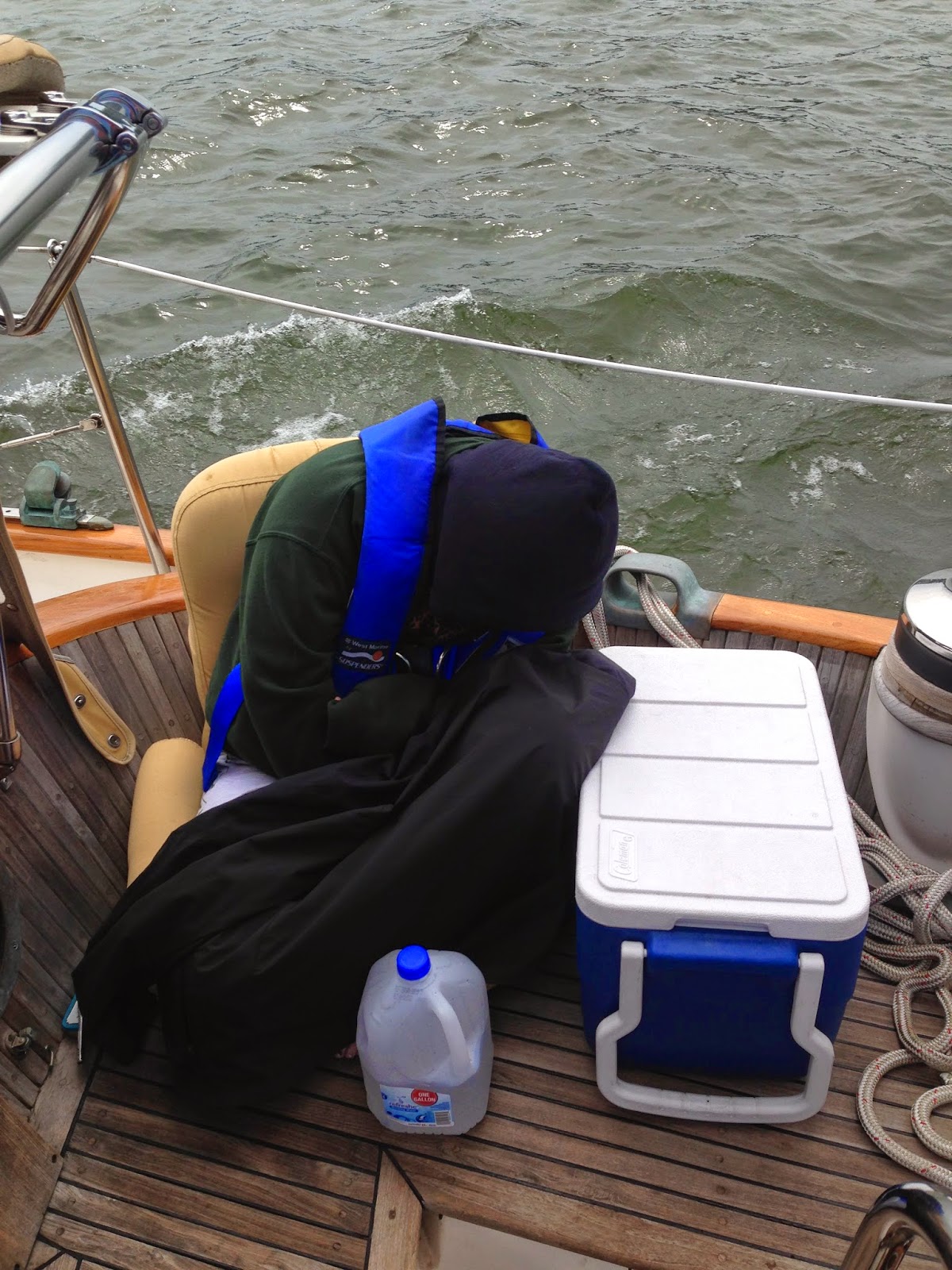
Of course as a college kid Katie wasn't up for early morning travel.  She pulled up one of the deck chairs and passed out for a while under a blanket.

Katie passed out

S/V Rowena
 I couldn't believe how lucky we were to be doing 7.6 knots SOG.

7.6 Knots on the GPS

Our auto pilot steering us along the way.

Katie finally woke up

She had something to drink
She had some lunch

Katie Sunbathing Oregon Style.

Church along the way

Astoria Bridge

 July 3rd, 2014

We spent the night in Astoria, at the West Basin Marina.  We conferred with Ray and Alicia and went out on the ebb flow of the Columbia Bar at 11:20am.

Heading out to the Columbia Bar

Looking at Ilwaco as we went out.
 As we were going out we were followed by the U.S. Coast Guard.

USCG following the CarolMarie out to the Bar.
 Once we got out to the bar the weather, and the sea conditions became to rough to take pictures.   We were beat pretty hard, going out 23 nautical miles to find an easy ride which didn't come until the early morning of the 4th of July.

Swells were 6-9 feet at 8 seconds most of the day of the 3rd.   We kept hourly check in's on the VHF with Rowena.  Both Ray and Alicia didn't fair their first night at sea very well.  Rowena suffered from a problem with her packing gland leaking, forcing them to have to go below and check things out all through the night.

By 3:00am the morning of the 4th of July the sun began to raise at sea and everything settled down enough to motor sail.

Motor Sailing on the morning of the 4th.

Our calm voyage was short lived, by 10:00am I noticed the tachometer on the motor was bouncing around spastically.  Since the engine was rev'ing I deduced it must be the alternator, which was the case.   I called to Ray that we needed to pull into the next port call LaPush, Washington.  LaPush is famous for two things; the difficult harbor entrance and the werwolves of the series Twilight.

We cut back into the east to make it over to LaPush to find a new alternator, and as we past Destruction Island we heard a mayday call coming from a boat about 14 miles away.   The skipper reported seeing smoke and flames coming from beneath his decks.   Soon we could see Coast Gaurd helicopters hovering above the site where he said he was.  As more information came we heard that the skipper was the new owner of the 71 foot power boat that he purchased in California and was on the way back to his home port in Canada.  By the time we were close enough to see anything all we saw was the smoke from the wreckage floating over the horizon.


First smoke on the horizon.

Last plumes of the smoke we saw from the wreckage.
 About 5:30 PM we pulled into LaPush, Washington which is on the mouth of the Quileute River in Clallam County, Washington, United States. La Push is the largest community within the Quileute Indian Reservation and home to the Quileute tribe which seems to run the marina.  Gene the harbor master was excellent in finding us both a space.
Rowena at the fuel dock and CarolMarie in the background.

Restaurant in La Push.
Katie jumped off the boat and made friends with members of the tribe, watching fireworks with them and enjoying their hospitality.   Ray, Alicia,  and I had dinner at the community restaurant and then went back to our boats and fell asleep.

Katie's photo from the beach in La Puch

Cleaning fish at the harbor

Katie's fire on the beach at La Push


July 5th, 2014

When I woke up I went over to the harbor master's office to find out where to get an alternator.   Gene was AWESOME loaning me his car to find an alternator.  We ended up driving to Forks, where the local auto parts store is located.  The auto store was closed for the weekend of the 4th, so we drove to Clallam Bay to Cain's Marine.  At Cain's they had three different styles of alternators, and we ended up with a 60 amp single coil one that fit the bill.  It took an hour to install and we had the batteries charging again, but waited until the next day to head out.

July 6th, 2014

Early the next morning we left La Push, heading out toward Ucluelet BC.  Motor sailing again in the swells the 55 nautical miles to Ucluelet BC.

Rain and fog on the next part of the journey

  Upon arriving there we called customs, who told us to wait by the boat and some one would be there shortly to check us in and inspect the boat.   We waited for 2 hours and no one showed up.   I called back and the customer officer said the local officials had gotten busy that we just needed a number which he gave us.   We were checked into to Ucluelet!


Carolmarie at the customs dock

Houses along the inlet.

More homes in Ucluelet.

Ray and Alicia glad to be in Ucluelet.

Old fishing boat at the customs dock

The 52-Steps from the customs dock to the town

More of the homes along the water front.

Friendly Deer


Food Co-Op as their local market

Laundry where Katie did her clothes

Breakfast on the 7th


Shopping in the food Co-op

Service where the Co-Op brings your purchases to the dock.

Father and daughter happy to make it to Canada.

CarolMarie under a Canadian Flag.