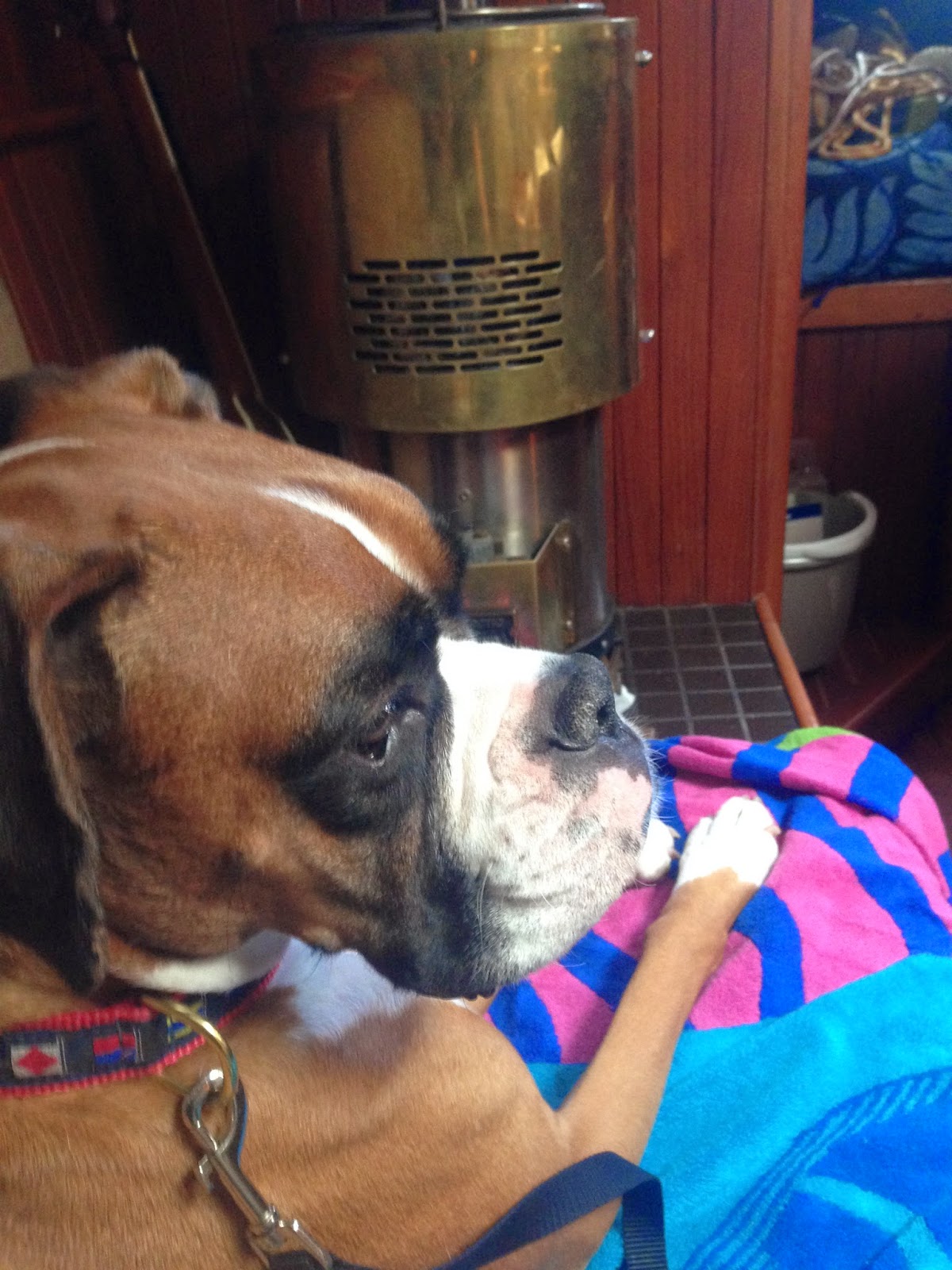
We finally got the old girl out yesterday for a brief sail before the rains came into to greet us. We had Murilo, Doug and his family, and Kevin with his girl Brittany. What great time to be out finally, the move to Hayden Island has been taking all year it seems like. Anyway here's some great pictures of the starboard side from Murilo.
S/V CarolMarie is a 1980 Hans Christian MKII sailboat. The blog here describes the adventures of her captain and crew as they find their way through various adventures.
Monday, September 7, 2015
Wednesday, May 27, 2015
Opening Day, A New Addition to the Fleet M/V Rioloco, and Brazilians Visit
Saturday May 2nd was opening day for the boaters on the Columbia River according to the Corthian Yacht Club. As my readers know I am banded from opening day. So Kona and I watched from the dock watching the world go by.
May 7th came along and we picked up an addition to our fleet of vessels, a 20 foot motorized pontoon boat. Charing christened her Rioloco, for her last name.
May 8th we celebrated our anniversary on Rioloco with Ray and Alicia. It was a blast circumnavigating Hayden and Tomahawk Island on her.
| Opening Day Parade on the Columbia River |
| Kona and I pouting in our cabin. |
| Charing at the helm of Rioloco |
| Harbor During Cruise |
| Harbor Image |
Friday, April 24, 2015
SIYC Navigation Cruise 2015
Our yacht club, which is a highly casual, very welcoming club, held it's Navigation Cruise last weekend. The cruise is really the first one of the season since the first cruise was cancelled due to weather in March. The navigation cruise begins actually a week or two before the cruise where the host hands out a packet of charts segments, tide table and current table segments, and a list of questions associated with marine navigation.
The quiz took me about six hours to complete, I had finished about two days before we took off for the cruise. Our yacht club's commodore Craig Johnston designed the quiz such that it told the story of your spouse, sister, your brother in law-Larry, and yourself aboard a charter boat the S/V Plastique. As the story progressed through the series of questions, your clumsy, haphazard brother-in-law pretty much destroys all the usable navigation technology aboard the charter boat.
April 17, 2015
I had gotten up very early (4:00am) in the morning and moved the all the provisions on board, including our new Bottom-Siders cockpit cushions, and our stay sail jib. Afterward went off to work for the day. Charing and I arrived at the boat about 4:30pm after work and began getting ready to leave. We untied the boat about 5:20pm and motored at 6 knots with a 2 knot current to arrive at Grandma's Cove about 6:10pm. Upon arriving we called out to everyone on our designated channel 69, but we got no answer. When we rounded the corner we realized why, we the first ones to arrive. Since we weren't certain where to drop anchor we tied up to the docks at Schooner Creek Boat-works until another boat arrived. The winds picked up through the next hour until they were about 18 knots inside the cove. About 7:00pm our good friends Ray and Alicia arrived on S/V Rowena. They docked near the north-west corner of the cove and beckoned over to anchor the opposite way so they wouldn't be blown into the shore. Ray pointed to the far western side of the cove and said to drop anchor there. We did, but soon realized we'd never get enough rode out to raft unto Rowena. We recovered the anchor, but not before having our first grounding on the new bottom. I backed off the grounding and anchored closer to Rowena under Alicia's instructions this time. Within no time we were anchored and rafted up to Rowena. Throughout what could have been a stressful adventure, Charing's attitude was outstanding, encouraging me with the phrase, well we have to learn how to do this anyway might as well do it again.
Ray and Alicia came aboard for dinner and drinks. We had a great time talking through the night.
April 18, 2015
We woke up late about 9:00am after a restful sleep. Charing and I both were looking forward to making coffee with freshly ground 100% Kona coffee. Those desires were not to be, as I'd forgot to check our propane tank; it was empty. Thankfully Alicia came to our rescue cooking the eggs and Portuguese sausage we brought for breakfast. She made some great coffee too. Alicia makes the world's best potatoes in the USA (Ireland is hands down the best.) As we finished breakfast we peered over Rowena's dodger to see S/V Sequoia on the far side of the Vancouver Railroad bridge. Several trains past, over the bridge until the bridge swung to the side allowing them to come into the bay. Craig and Barbara tied up next to us on our starboard side. Gary Weber came next, tying up to Rowena. JuliaMax made her way into the bay shortly after, rafting up to Sequoia. Terry and Michelle on Conch came next rafting up to JuliaMax. Paul on Openwater came in as well rafting up to Gary. Maria Victoria was the last to come into the raft joining S/V Conch.
By about 3:30pm Gabrielle, Michael, David, and Kim Winkler came in by car and ported over thanks to Ray's dinghy. Craig held the answer session in the cockpit of his boat.
The quizzes were ranked into three categories, Bluewater cruisers, Coastal Cruisers, and Novices. The Bluewater award went to Julia Max, the Coastal Cruiser award went to Rowena, and the CarolMaire took the Novice award. The Novice classification came from the fact it was our first time to compete. CarolMarie accepted the award of a Current and Tide Flow book for the San Juan Islands.
Following the quiz a pot luck dinner was hosted aboard CarolMarie due to her being the middle of all the boats in the raft.
Following dinner everyone had desert on Sequoia, and socialized on various boats.
Gary, Paul, Ray, and Alicia joined us for a nightcap on CarolMarie. We then turned in for the night.
4/19/2015
After a group breakfast the flotilla broke up, and everyone went on their way home. Charing and I stopped at the pump out station deciding to clean out the holding tank with various types of treatments to ensure a clean smelling boat for the next time out. We docked about 4:00pm in our slip, spending a couple of hours cleaning the hull, deck and putting everything away.
The 2015 SIYC Navigation Cruise was over - it was a blast, despite the antics of fictional Larry; the brother-in-law that ruined all the electronics on the boat. Thanks to Craig and Barbara Johnston for hosting, and sharing pictures.
The quiz took me about six hours to complete, I had finished about two days before we took off for the cruise. Our yacht club's commodore Craig Johnston designed the quiz such that it told the story of your spouse, sister, your brother in law-Larry, and yourself aboard a charter boat the S/V Plastique. As the story progressed through the series of questions, your clumsy, haphazard brother-in-law pretty much destroys all the usable navigation technology aboard the charter boat.
April 17, 2015
I had gotten up very early (4:00am) in the morning and moved the all the provisions on board, including our new Bottom-Siders cockpit cushions, and our stay sail jib. Afterward went off to work for the day. Charing and I arrived at the boat about 4:30pm after work and began getting ready to leave. We untied the boat about 5:20pm and motored at 6 knots with a 2 knot current to arrive at Grandma's Cove about 6:10pm. Upon arriving we called out to everyone on our designated channel 69, but we got no answer. When we rounded the corner we realized why, we the first ones to arrive. Since we weren't certain where to drop anchor we tied up to the docks at Schooner Creek Boat-works until another boat arrived. The winds picked up through the next hour until they were about 18 knots inside the cove. About 7:00pm our good friends Ray and Alicia arrived on S/V Rowena. They docked near the north-west corner of the cove and beckoned over to anchor the opposite way so they wouldn't be blown into the shore. Ray pointed to the far western side of the cove and said to drop anchor there. We did, but soon realized we'd never get enough rode out to raft unto Rowena. We recovered the anchor, but not before having our first grounding on the new bottom. I backed off the grounding and anchored closer to Rowena under Alicia's instructions this time. Within no time we were anchored and rafted up to Rowena. Throughout what could have been a stressful adventure, Charing's attitude was outstanding, encouraging me with the phrase, well we have to learn how to do this anyway might as well do it again.
Ray and Alicia came aboard for dinner and drinks. We had a great time talking through the night.
April 18, 2015
We woke up late about 9:00am after a restful sleep. Charing and I both were looking forward to making coffee with freshly ground 100% Kona coffee. Those desires were not to be, as I'd forgot to check our propane tank; it was empty. Thankfully Alicia came to our rescue cooking the eggs and Portuguese sausage we brought for breakfast. She made some great coffee too. Alicia makes the world's best potatoes in the USA (Ireland is hands down the best.) As we finished breakfast we peered over Rowena's dodger to see S/V Sequoia on the far side of the Vancouver Railroad bridge. Several trains past, over the bridge until the bridge swung to the side allowing them to come into the bay. Craig and Barbara tied up next to us on our starboard side. Gary Weber came next, tying up to Rowena. JuliaMax made her way into the bay shortly after, rafting up to Sequoia. Terry and Michelle on Conch came next rafting up to JuliaMax. Paul on Openwater came in as well rafting up to Gary. Maria Victoria was the last to come into the raft joining S/V Conch.
![]() |
| SIYC Navigation Cruise Raft Up the very stern of CarolMarie is seen (courtesy Gabrielle Drowding) |
By about 3:30pm Gabrielle, Michael, David, and Kim Winkler came in by car and ported over thanks to Ray's dinghy. Craig held the answer session in the cockpit of his boat.
| Terry and Charing going through the answers from the quiz. |
| Everyone checking their answers |
Following the quiz a pot luck dinner was hosted aboard CarolMarie due to her being the middle of all the boats in the raft.
| People having dinner aboard CarolMaire (courtesy Barbara Johnston) |
| Buffet on the deck CarolMaire (courtesy Barbara Johnston) |
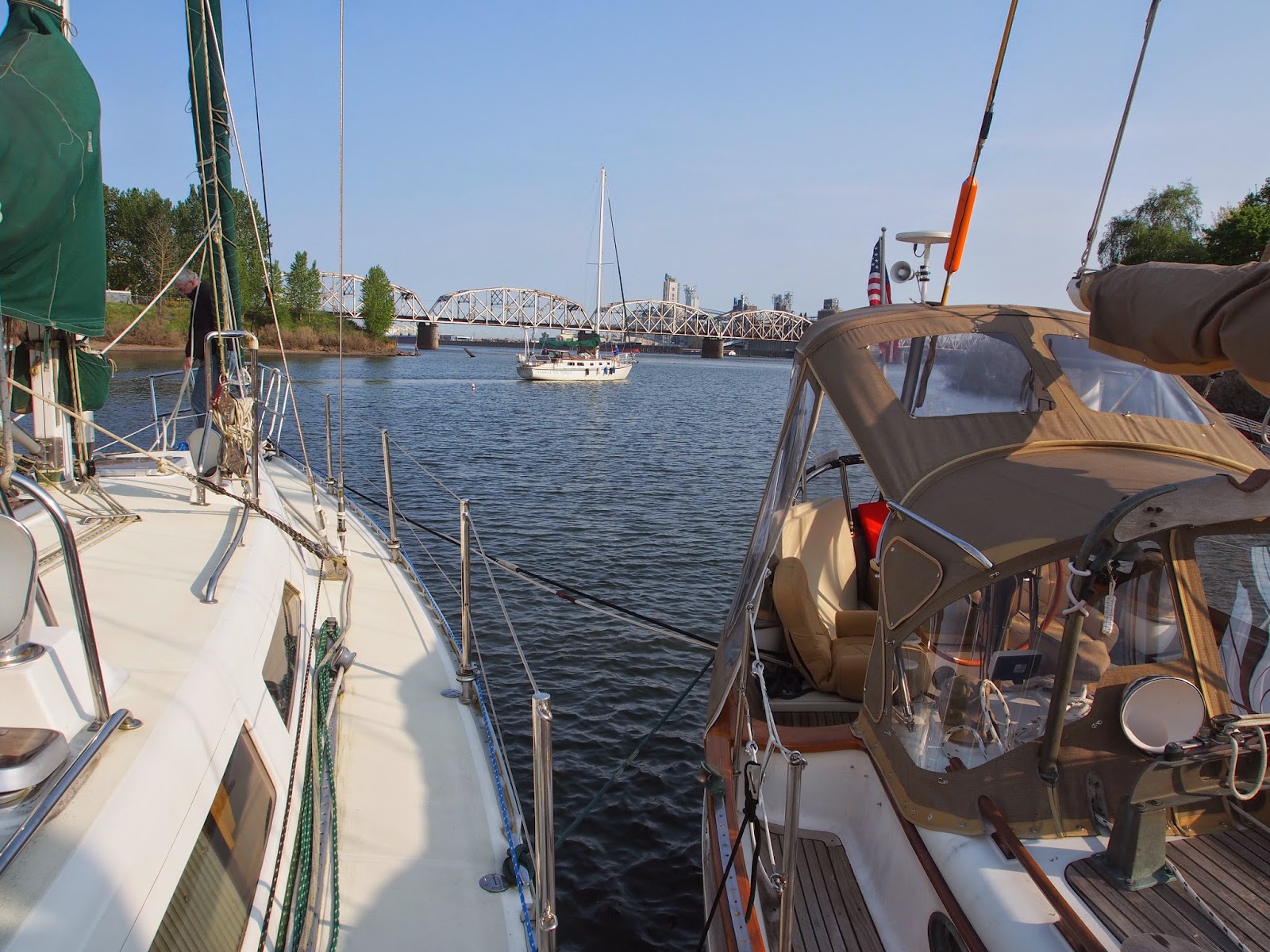
| Sequoia and CarolMaire rafted up (courtesy Barbara Johnston) |
| Gary Weber having dinner aboard CarolMaire (courtesy Barbara Johnston) |
| Ray and Michael discussing rigging on Rowena and the stern of CarolMaire (courtesy Alicia Watkins) |
Gary, Paul, Ray, and Alicia joined us for a nightcap on CarolMarie. We then turned in for the night.
4/19/2015
After a group breakfast the flotilla broke up, and everyone went on their way home. Charing and I stopped at the pump out station deciding to clean out the holding tank with various types of treatments to ensure a clean smelling boat for the next time out. We docked about 4:00pm in our slip, spending a couple of hours cleaning the hull, deck and putting everything away.
The 2015 SIYC Navigation Cruise was over - it was a blast, despite the antics of fictional Larry; the brother-in-law that ruined all the electronics on the boat. Thanks to Craig and Barbara Johnston for hosting, and sharing pictures.
Monday, April 20, 2015
Book Review of Astoria
In sailing up and down the Columbia River I always wondered
what the context was for the European settlements along the river. Because of work, I have been traveling a
great deal, for example New York City one week followed by a trip to India for
the following week. Last week while
going through the Portland Airport I ran across Peter Stark’s book entitled
Astoria: Astor and Jeffrson’s Lost Pacific Empire.
Stark begins with John Jacob Astor at the age of 21 climbing
off a passenger ship in 1784 onto the Chesapeake Bay. From then until 1808
Astor made his fortune in New York and was dead set on creating a legacy of a
new world on the West Coast of the continent. Astor had several meetings with Jefferson both
of who see the West Coast as a paradise that could be a new country or at least
part of America. The English had other
claims with the mapping and claims of Captain James Cook voyages. In September 1810 two parties, one overland
and one by sea set out toward the mouth of the Columbia River, to set up a
series fur trading outposts from the mouth inward up river. The furs of beaver, mink and others would be
shipped to Canton China and tea brought back to New York from China. For a $20,000 investment Astor would make
$400,000 in 1810 dollars.
Astor hires Captain Jonathan Thorn to be the ship’s master
of the
sailing bark Tonquin. Astor also
offers “shares” to others to join the venture, putting Wilson Price Hunt in
charge and Duncan McDougall as second in command. McDougall went aboard the Tonquin
and arrived in March 1811 into Astoria. They had sailed for over one year, from
New York, around Cape Horn to Hawaii where they ran into a storm forcing them
to dismast in heavy seas. They made it
back to Hawaii, picking up several Hawaiian watermen to join their venture, and
to repair the ship. The entire way
McDougall and the other Scottish partners take great enjoyment in badgering
Captain Thorn. Most of the badgering leads
to Thorn breaking out in fits of rage which delights the scots to no end.
Once in Astoria the McDougall establishes himself as a king
like figure on land establishing a “tent on state” on the Oregon side of the
Columbia. He kept this position
running until the arrival of Hunt in the spring of 1812.
Meanwhile, fed-up with McDougall, Captain Thorn weights
anchor in June 1811 and sails toward Vancouver Island to trade furs with the
Clayoquot tribes. The Clayoquot being
savvy in the way of trading fail to accept Thorn terms. Thorn after being tormented by the scots was
in no mood to deal with the Clayoquot.
He threatens them leaving to a shooting.
The shooting outrages the Clayoquot which storm the ship leaving to
fights that leaves all but 7 dead on the ship.
The next day the Clayoquot storm the ship once more, leading one of the
Europeans to ignite the power keg blowning up the ship. Only one member of the party remained alive
and over 200 Clayquot blown to bits.
Reportedly bodies washed upon shores for days.
After not hearing from Thorn the next spring Hunt jumps on
another ship the Beaver and heads offshore leaving McDougall in charge. Astor hears of the Toquin later and fears the
supply will run low and his venture in the west will be acquired by the British
as part of the oncoming war of 1812.
Astor goes back to the President now Madison and demands
ships to protect Astoria from the English.
His request, despite funding a large part of the war falls on deaf
ears. Astor discouraged that the new US
government won’t protect his investment, he purchases two gunships the Lark and
the Forester. The Lark was recognized to
be a fast moving stealthy gunship, taking the same route as the Toquin to
resupply in Hawaii. The Lark sinks there
in Hawaii. Meanwhile the British own
Western Trading Company asserts it’s claim on Astoria to McDougall. McDougall being a Scotsman didn’t want to be
hung for treason and sells out to the English company for pennies on the
dollar. The Forester being a heavier
ship sails to Hawaii where the ships crew hear the fate of those that have gone
on before them and mutiny, taking over the ship, never going to Astoria.
Of the 140 men that left for Astoria, 61 died in the total
venture. Hunt became the Postmaster of
St. Louis, McDougall was killed working for the North West Trading Company. In
2006 the Clayquot Nation was reduced to 174 people. In that year the anchor of the Toquin was located. Astor lived long enough to
see the Oregon Country become a US territory in 1848. The foundation of the territory lends itself
to the creation of the famed Oregon Trail, a path that the Astorians fled back
toward the US east coast. Astor died as
the richest man in the US, his fortune amounting to $110 Billion in today’s
USD.
Stark tells a wonderful story combining venture capitalist,
their influence on the government officials, adventures in sailing, adventures
in overland exploration, and an entire course in how not to manage a
startup. For the three days I travelled
on the plane I had a hard time putting the book down. Definitely a recommended
read for anyone interested in history, or sailing, venture capital, or
management structure.
Subscribe to:
Posts (Atom)